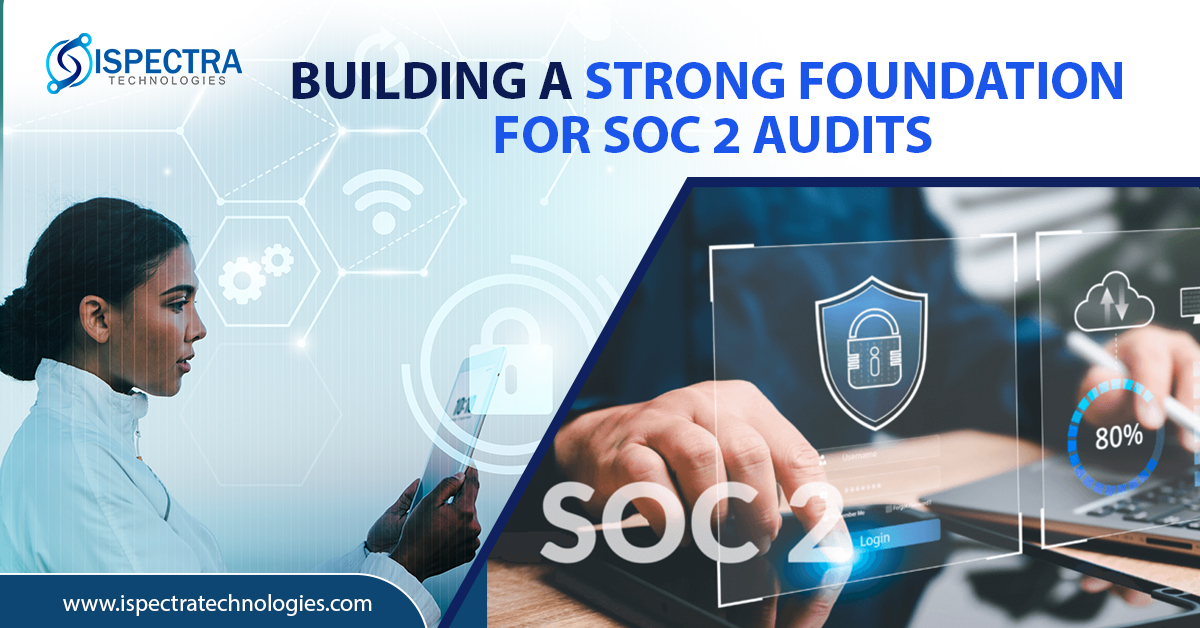
Building a Strong Foundation for SOC 2 Audits

Businesses today are storing increasing amounts of data on customers, and it is not just the users who are concerned about the safety of their data. One of the compliance standards that has emerged in an effort to ensure data protection is Service Organization Control 2, or SOC 2 reports. While SOC 2 standards aren’t part of a law or regulation, they are equally important to your business if you handle customer data. It offers flexibility without sacrificing security rigor.
However, complying with SOC 2 requires a comprehensive audit of your organization’s systems, processes, and controls. Preparing for such an undertaking is no easy feat. To help, we have compiled a checklist of pre-audit steps that can help you maximize your chance of passing that audit. But before that, let us take a look on how a SOC2 report can help your business.
How is SOC 2 Report Beneficial for your Business?
If your company provides technical solutions, the first step in earning the trust of customers is providing assurance over your scope with the AICPA’s Trust Services Criteria (TSCs) through a SOC 2 report. In particular, service organizations benefit from the following advantages of having a SOC 2 report:
- Offers peace of mind that your security controls are designed and operating effectively over a period of time (Type II)
- Efficient and effective response to IT, data security, and due diligence questionnaires from customers and/or partners
- Ability to provide assurance to clients and partners that your business meets their standards, expectations, and their compliance requirements
- Helps win more customers, boost sales, and gain an advantage over the competition by creating trust
Your 8-step checklist to prepare for and pass your SOC 2 audit
The process of getting SOC 2 compliance is not as easy as going for an audit. You have to implement controls to achieve objectives of any criteria of trust services, assess the existing gaps, and eliminate all of them before the audit.
However, to increase your chances of emerging successful in the audit you have to ensure that your team observes the best practices of information security controls. To assist with this, we developed an 8-stage guide for audit readiness below:
-
Select your report type
First of all, you must choose the type of an SOC 2 report, which is to be prepared. There are usually two types of report:
- Type 1: To determines the overall efficiency of controls as applied to the organisational design in just one moment in time.
- Type 2: Takes an appraisal of the design and also efficiency of controls after some time of its implementation usual time range of take-off is 3- 12 months.
Due to the fact that Type 1 only examines the extent to which design is effective at a particular point in time, it will be less consuming in terms of time and resources. Though Type 2 is far more intensive, this type is valuable for the extent to which your control activities are constructed and function.
-
Understand SOC 2 audit scope and goals
The next step in every preparatory process for your SOC 2 audit is to discuss and determine the scope and the goals. SOC 2 SSAs consider infrastructure, data, people, risk management policies and procedures, software and others.
You must identify what and who within each of these categories will be up for audit. Following this it is necessary to determine what kind of objectives are set for the in-scope systems or services. This information can normally be gleaned out of contracts, service level agreements, or other similar publicity.
-
Choose your selection of trust services
SOC 2 audits measure the effectiveness of the controls you implemented within the previously mentioned audit scope against the trust services criteria. It includes five trust services for the SOC 2 compliance requirements:
- Security: The process of preserving information and systems from misuse, leakage of information or other forms of misuse/damage.
- Availability: This type of information illustrates that information and systems are available for your organizations operation and can provide service levels which may align with those laid down in service level agreements.
- Integrity: Your systems function efficiently, effectively, as they should, in terms of time, and in ways that will help your organization meet its objectives.
- Confidentiality: The organization implement non-personal data and information collection, use, retention, disclosure, and disposal.
- Privacy: You process peoples’ personal information: collection, use, retention, disclosure and disposal appropriately.
However, you don’t have to go for an audit on all the five, all at once. The only principal that is required is security and the rest of them are optional based on the type of firm. If the audit is short on resources, you can choose criteria in conjunction with security that will give the highest possible ROI or those that are almost possible without a whole lot more effort required.
-
Conduct a risk assessment
You need to define what threats exist in relation to the information assets, technology, applications, individuals, processes, data, and systems that impact on the achievement of the business goals. In the assessment phase, you will have to evaluate the probability of likelihood regarding a risk as well as its business consequence. It is then possible to sort them according to the overall risk posed to your organization.
Each risk requires an adequate response and this ranking will assist you in doing the right thing if you consider the ranking. This may involve setting up or revising a business ‘Contingency’ as is often referred to plan, procurement of technology investment, or implementing access control or other security measures to reduce the overall risks to an acceptable level.
-
Perform the first readiness scan
After having established policies, processes, and controls for risk management, you are prepared for a readiness assessment. A readiness assessment is quite similar to a mock SOC 2 type of examination. In a readiness assessment, an auditor physically takes the client through all the systems, processes and controls and highlights key processes as would be observed in the official audit.
Once done, they release a management letter containing any weaknesses or shortcomings of the company that relate to each trust service requirement as well as some suggestions for their rectification.
-
Undertake a gap analysis and remediation
Following the readiness assessment, it will be pertinent to conduct a gap analysis. It includes assessing where you are organization stands, what is expected at your level of compliance in relation to SOC 2 trust criteria, and then remedying any issues you discover. Gap analysis and remediation can take a few months and may involve:
- Implementing controls
- Interviewing employees
- Control self-training of employees
- Control setup and modification
- Modifying workflows
There is an option in which you can use a compliance automation tool adopted instead. It can scan all of your systems and controls at once and identify that they are compliant with SOC 2 or not and what are the major issues that you are facing.
-
Employ a procedure
Once you have identified gaps you need to close you should have in place a way to monitor the effectiveness of your controls overtime. You can use a compliance automation tool. It will enable you to automate the feed of controls in real time to easily seek a much more reactive looking view of the controls.
Additionally, it will also allow organizations to track a lot more security metrics with relatively less effort, more frequently and with larger sample sizes. Finally, when you consider that you’ve discussed and responded to all issues that refer to your scope and trust services criteria, it is time to get a formal SOC 2 audit.
-
Find a SOC 2 Auditor
When the AICPA developed the SOC security guidelines, any CPA firm can conduct your audit on your behalf. However, when making selection, you need to ensure that you choose a CPA firm that has a specialty in information systems.
If you are in a company now that doesn’t have CPAs with information systems experience and knowledge, then you have no other option than to hire another firm to conduct an audit. Your current legal counsel may suggest some steps for preparations, however, if you are going to engage a specialized information security work, your chances of passing an audit will be higher.
Conclusion
The more your SOC 2 compliance program starts to evolve and become more efficient, the less stress is caused by addressing SOC 2 controls attestation and auditing as a one-time activity. So, it is crucial to succeed in the preparation for the positive opinion on the SOC 2 report, and remember that compliance environment is your recipe to success.
Categories
- Cloud Engineering (3)
- Cloud Transformation (11)
- Cyber Security Services (24)
- DPDP (3)
- GDPR Services (4)
- Healthcare (6)
- HIPAA (1)
- ISO 27001 certification (5)
- RCM (1)
- Revenue Cycle Management (1)
- SIEM (2)
- SOC 2 (2)
- SOC 2 Audit (28)
- SOC 2 Compliance (16)
- Software Engineering (6)
- Strategic Risk Management (SRM) (2)